|
|
Home | Blog | Crosses | History | Articles | About | Resources |
The Collection"About all you can find in either room now is crosses, paintings of Christ, crosses, nativity scenes, crosses, madonnas, and more crosses." Rev. Stiver organized his collection by country of origin, corresponding to his travels, or by form or theme, such as crosses made of nails. Crosses were affixed with wire on pegboard panels covered with red velour, each 16 by 22 inches. While there are many small crosses, ranging from 1/2 inch to 3 inches in height, a substantial number were large enough to be seen clearly from across a room. These formed the basis for his sermonettes for children, where the cross represented a story of faith with a unique design that characterized a country or location. Most crosses are unique. They include folk art, replicas of famous crosses, souvenirs from sacred places, fine jewelery, and crosses made from home workshops. A few crosses are relatively old, with the oldest Christian item being a simple bronze cross from around 6th century. About 5 precent of the collection came as gifts from members of his congregation, neighbors, missionaries, and strangers. Some of the older crosses show the wear of being stacked in a car and shown at many different times. On a replica of a Spanish majestic crucifix (Christ wears a long priest’s robe instead of a loin cloth), for example, the nose has been almost completely rubbed off. A bronze replica of a crucifix from the Congo was dropped, shattered and then restored. Crosses are made of different materials as well as from different countries and cultures. Along with the obvious materials of wood and various metals, crosses are made of straw, beeswax, yarn, lace, paper, ribbons, palms, and hair.
|
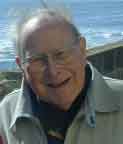
About This SiteThis website is based on the cross collection of Rev. Stanley L. Stiver, who at the age of 89 passed away on May 16, 2011. Rev Stiver collected crosses for most of his 60+ years as a Lutheran minister. Crosses as well as other religious objects were an important part of his ministry. He loved to tell a story of faith and devotion based on a cross while also describing the details of its origin. More information about his life can be found on his biographical website.Collector of Crosses
The Rev. Stanley L. Stiver began collecting crosses shortly after his ordination as a Lutheran minister in 1947. His collection grew to contain over a thousand unique pieces from different countries and cultures. About his fascination with the cross, he says, "It’s a sign of the triumph of Christianity. A risen Christ is what really makes our Christianity." More than just a hobby, his collection became part of his ministry. During church services, a cross or other object became a topic for a sermonette for children. He also presented and displayed his collection to many groups across Catawba County and North Carolina. For 13 years, he was featured at the Southern Christmas Show in Charlotte, where thousands saw his exhibits. A number of prominent newspaper articles featured his crosses and other items. Beginning in 2006, he donated his crosses to different organizations. In 2007 he remounted and gave over half of his collection to St. Mark's Lutheran Church in Claremont, North Carolina. For a few years, they were on a rotating display in the windows of the parish hall. Due to damage from the sun, they were taken down. Crosses and other objects from the Holy Land were framed and are on display at the Lutheran Home in Hickory, North Carolina. He donated the remainder of his collection to Lenoir-Rhyne University. The Rev. Stiver was ordained a Lutheran minister in 1947 by the Evangelical Theological Seminary (now Trinity Lutheran Seminary) in Columbus, Ohio. He had wanted to be a minister since he was 12. After ordination, he accepted calls to New Orleans (St. Luke's, 1947-51); Wheeling, West Virginia (St. Mark's, 1951-59); and Claremont, North Carolina (St. Mark's, 1959-1990). A man of boundless energy, he was very active in community service and the Red Cross. After retiring from St. Mark's, he moved to Hickory and has served various churches in the area. From 2000 to 2009, he was visitation pastor for St. Andrew's Lutheran Church in Hickory. Son of Collector of Crosses
David J. Stiver, son of Rev. Stiver, is a librarian and assists with special collections at Graduate Theological Union, Berkeley, California. He also manages the web site and online surveys for EPARG, the Emotions, Personality, and Altruism Research Group, Wright Institute, Berkeley. He has worked in corporate archives at Gap Inc., spent many years as project and account manager for Xerox, and was reporter and editor for The Observer-News-Enterprise, Newton, North Carolina. This project began in 1999. It started with the idea of producing a small book to capture the stories and crosses of the Rev. Stiver. As each bit of descriptive information led to many more questions, the project expanded in different ways. Since 2005, this site has been a holding place for a portion of the iconographic information. In 2007, a site celebrating Rev. Stiver's 60 years in the ministry was put up. The third piece was published in December 2011, a book that is an expanded version of the website. He lives in San Francisco with his wife, Lynn, a clinical psychologist and professor, and two cats. Contact information23rd Street PressPO Box 460241 San Francisco, California 94146-0241 Email: administration (at) crosscrucifix (dot) com |
| Home | Blog | Crosses | History | Articles | About | Resources |